

The Familiar, Reimagined: Inside the Paintings of Estelle Simpson
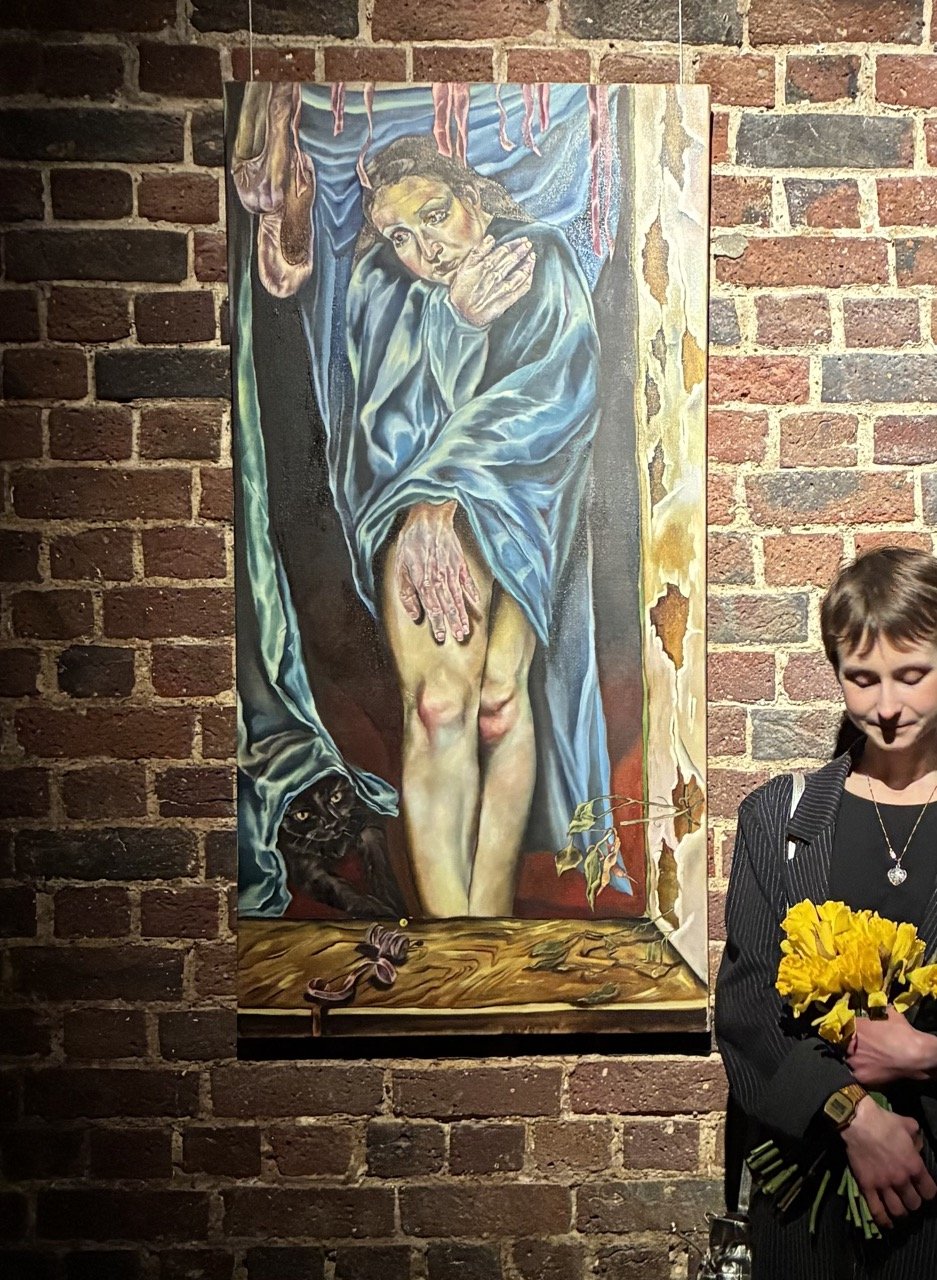
Estelle Simpson photographed alongside her painting. 2026
Before a painting finds its way onto a gallery wall, it often exists somewhere far less visible. It may first appear as a fleeting image before sleep, linger as a feeling that refuses to leave, or survive quietly inside a sketchbook, never intended to become a finished painting at all.
When we spoke with Estelle Simpson, we chose not to begin with one of her completed works. Instead, we asked a different question.
Where does an image begin?
Rather than showing us a finished canvas, Simpson opened her sketchbook and invited us into the earliest stage of her imagination.
A Glimpse into Her Imagination (Arthoods Exclusive)
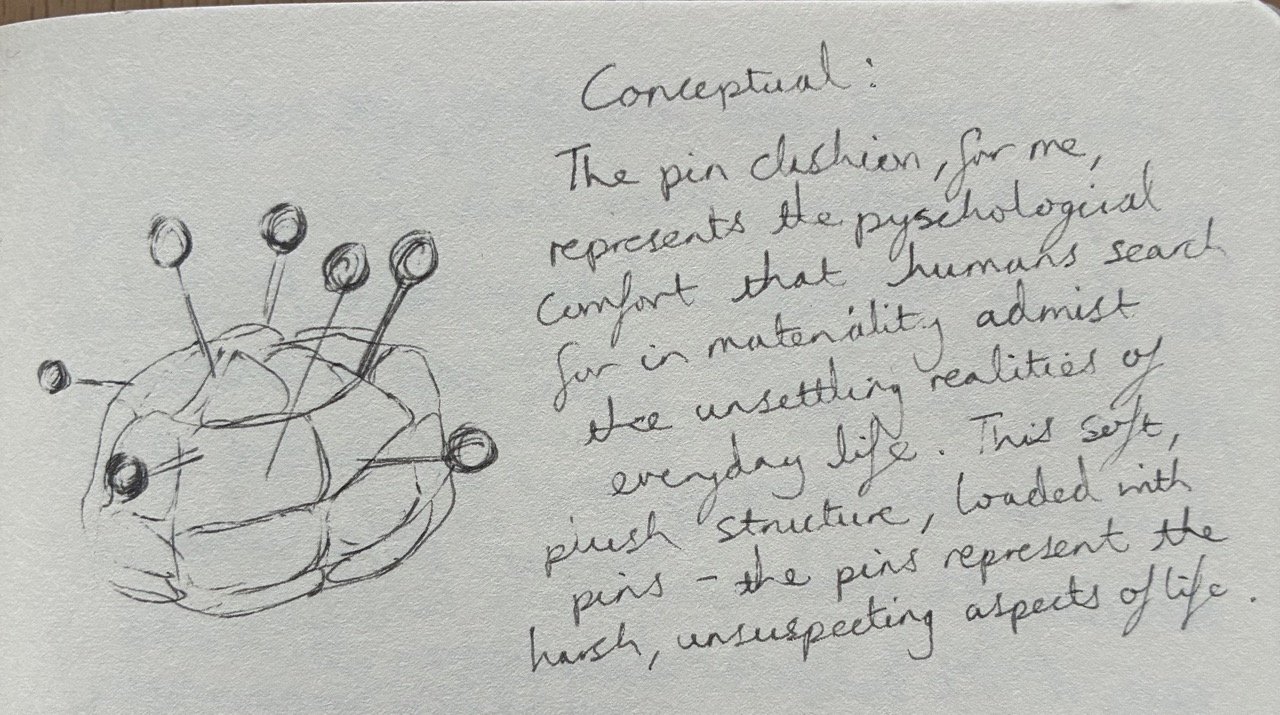
Excerpt from artist notes from sketchbook. 2026.
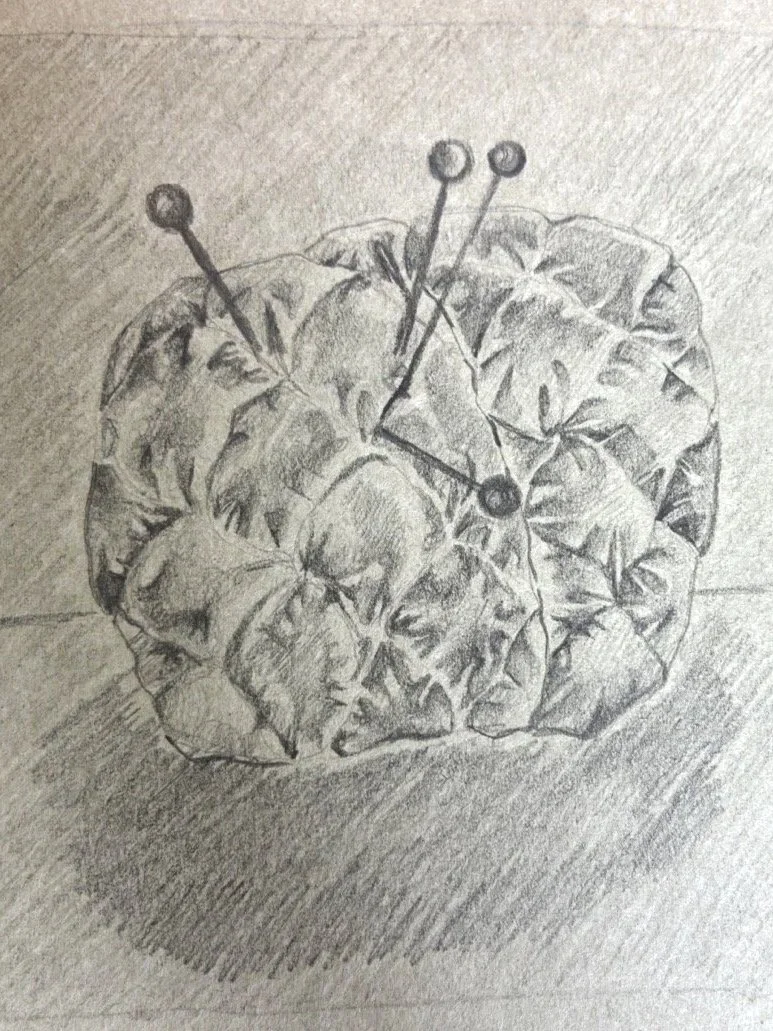
Sketchbook study of a pin cushion, 2026
Don't scroll.
Look at it first.
What do you see?
Soft.
Quilted.
Pierced.
Yet, for Simpson, it is already a psychological landscape.
"Painting is a way to visually explore the complexities of the inner being. Every reference has a connection to reality."
The pin cushion has recently emerged as a recurring motif throughout her work, joining a family of textile forms that already inhabit her paintings: quilted cushions, mattresses, billowing skirts and upholstered interiors. These are not passive objects. They breathe, compress and stretch, behaving less like objects than living beings..
"They serve as animated objects," she explains. "Their softness exaggerates the way things stretch, compress and settle into place, mirroring something deeply carnal." What makes the pin cushion especially compelling is its contradiction. It offers comfort, yet it is constantly wounded.
"It embodies the human search for physical comfort amidst the unsettling realities of everyday life. The pin cushion is a particularly loaded image because it is pierced, creating an interesting tension between harsh and soft."
Looking at these small studies, it becomes clear that Simpson is not sketching objects. She is sketching emotional states.
Where Images Begin
When does a painting actually begin?
For Simpson, the answer arrives long before the brush touches the canvas.
"I feel compelled to portray images which form in my mind's eye."
Rather than working directly from observation, her paintings emerge from an interior landscape where imagination quietly accumulates into imagery. Drawing plays a fundamental role within this process. Not every drawing is destined to become a painting. Some remain charcoal studies forever. Others slowly demand the scale and materiality of oil paint.
"Some images don't need to be more than a charcoal study for me, whilst others need to be developed in oil painting."
These drawings are not merely preparatory. They are a way of thinking. A way of discovering what belongs and what should disappear. Instead of pursuing anatomical perfection, Simpson seeks emotional precision.
Referencing painters such as Otto Dix and Käthe Kollwitz, she embraces expressive distortion over technical exactitude, allowing gesture, atmosphere and psychological intensity to guide the image.
Learning to Look Again
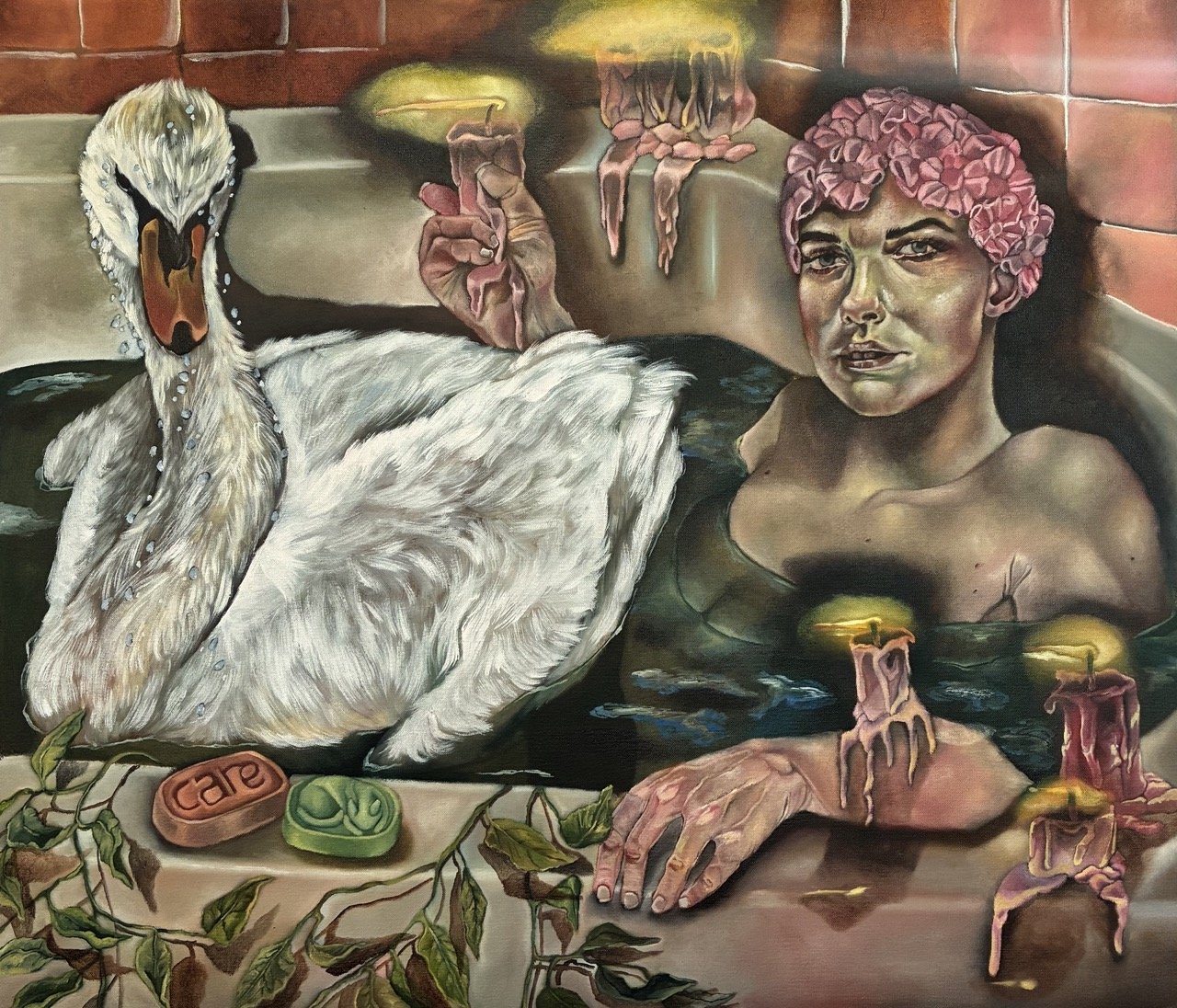
Self Care, 2026
One of the questions we asked Estelle was deceptively simple:
What do people almost always miss when they first encounter your paintings?
Her answer transformed the way we looked. The obvious figure may hold our attention first, but the paintings continue to unfold elsewhere: in the corner of a room, within the obscurity of a shadow, or across the surface of skin.
A pair of bird-like scissors hangs quietly from a branch in Portiere Labyrinthine (2025). A bar of soap gradually becomes a cat in Self Care (2026). Pins puncture clothing, furniture and even flesh, subtly shifting the emotional weight of a scene.
"A painting can continue giving meaning, and I like this way fragments of a narrative can slowly bleed out of the canvas."
These details rarely announce themselves. Instead, they wait. Simpson asks viewers to suspend their expectations of how ordinary objects should behave. Only then can the paintings begin to reveal themselves.
The candle wax no longer drips only into the bathtub; it begins to run down the figure's arm. Domestic rituals become quietly unsettling, comfort becomes fragile, and the familiar slowly turns strange.
When Objects Begin to Speak
Rather than asking Estelle what her paintings mean, we asked something different. If one of her paintings could ask us a question, what would it be? Without hesitation, she chose Soft Touch.
"What mask do you wear?"
The question lingers. Not because it demands an answer, but because it quietly redirects the painting back towards its viewer. Perhaps that is what Simpson's paintings do best.
They are less interested in explaining themselves than in asking us to reconsider our own emotional landscapes.
The Quiet Companion
Not every object in the studio carries symbolic meaning. When asked to choose one object that has quietly accompanied her practice over the years, Simpson surprised us.
It wasn't an heirloom.
Nor a favourite brush.
Nor even a sketchbook.
It was simply a jar of instant coffee.
"It's there when I first arrive in the morning, when I need something to perk me up after the day job, when I'm just sitting reflecting, or when I have a break. It's practical. I don't fuss about quality—the cheapest will suffice."
There is something wonderfully grounding about this answer. In the paintings, everyday objects become psychologically charged. In the studio, however, everyday life continues exactly as it is.

The object Estelle chose as her quiet studio companion.
When a Painting Begins to Change
Although Simpson often begins with a clear image, she rarely expects it to remain unchanged. Each painting is allowed to evolve. A slight movement of an eyelid, a subtle adjustment of an eyebrow, or simply the direction of a gaze.
These seemingly insignificant decisions can completely transform the emotional atmosphere of a painting.
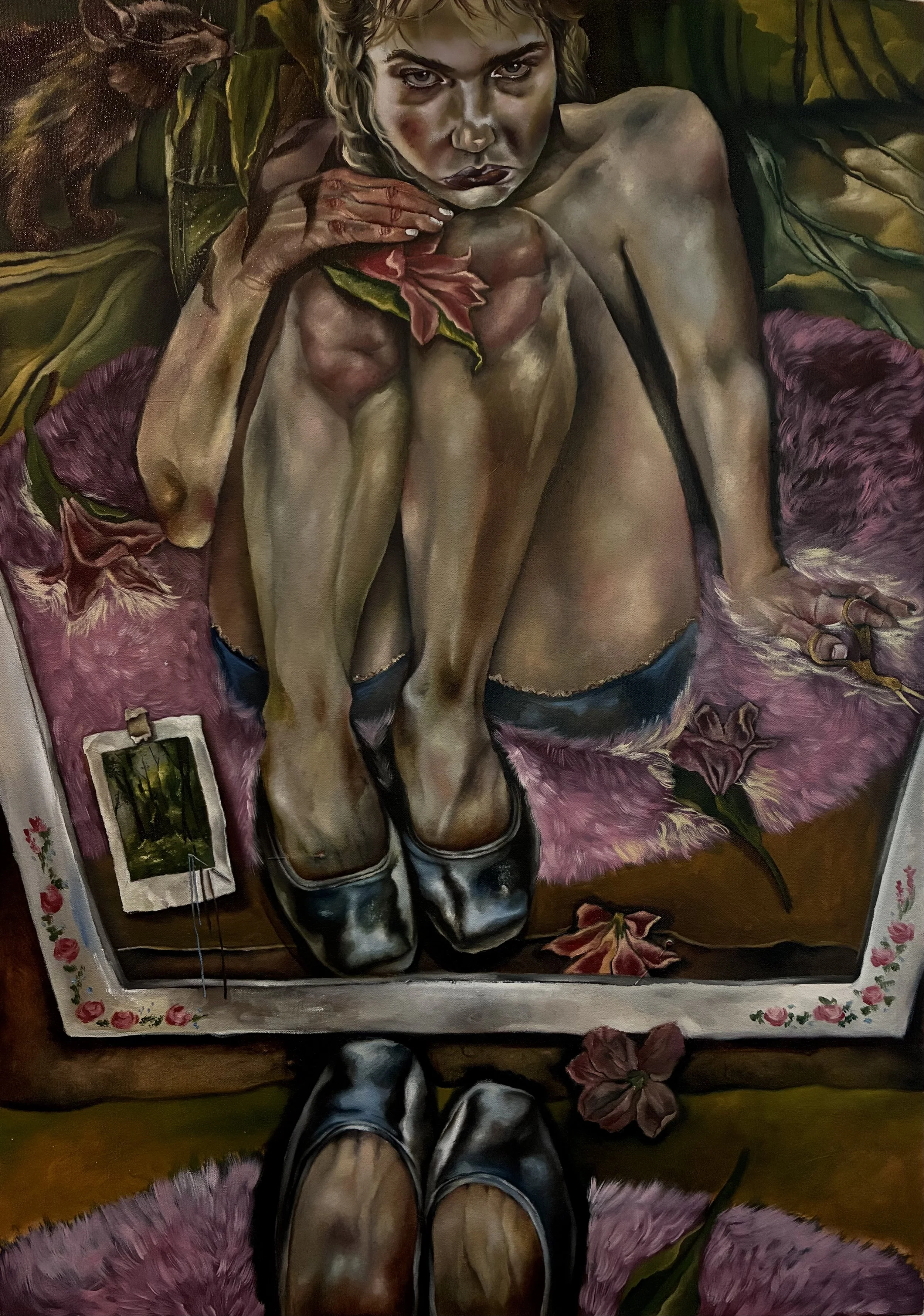
Guilt Cut Like Giselle's Lily, 2026
She recalls Guilt Cut Like Giselle's Lily (2026), where the central figure gradually shifted from passive to confrontational. Rather than lowering her eyes, she faces her own reflection. Yet, because we occupy the mirror's position, she is ultimately looking directly at us. The painting quietly breaks the boundary between image and viewer. Suddenly, we are no longer observing the work. The work is observing us.
Some Things Should Remain Unanswered
We asked Estelle whether there was a question she wished people asked her more often. Her answer was beautifully simple.
"Everything is presented in the painting that I wish to reveal—and conceal. I paint to avoid over-explanation in words, and I hope viewers will understand, or misunderstand, as much as they do."
Perhaps there is no clearer way to understand her practice.
Meaning is never fixed. Misunderstanding is simply another way of looking.
The Question That Remains
Rather than ending by asking what comes next, we asked Estelle a different question: what thought continues to occupy her mind?
Her answer returned to Petite Batterie (2026), where a human figure gently cradles a bat.
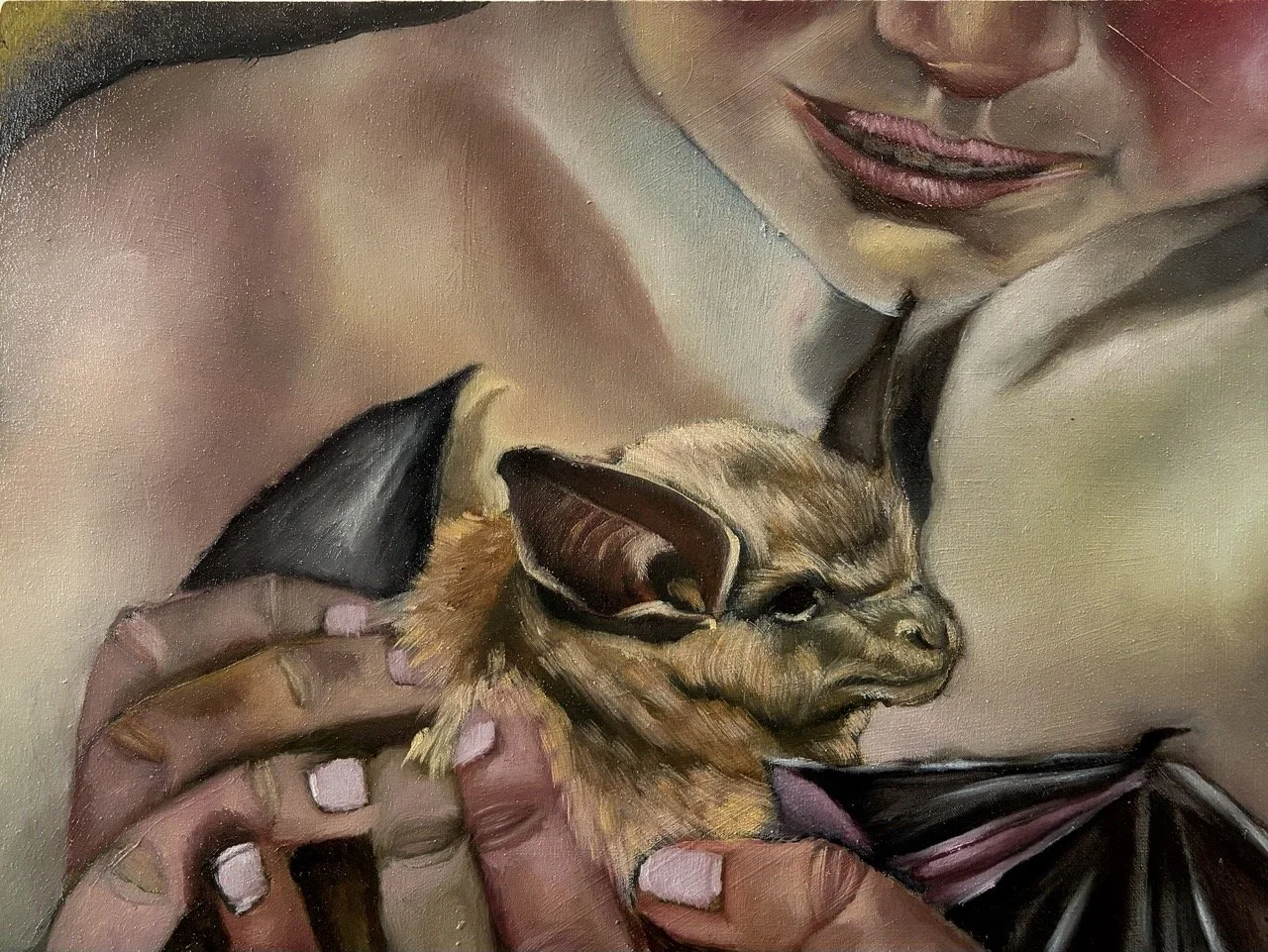
Petite Batterie, 2026
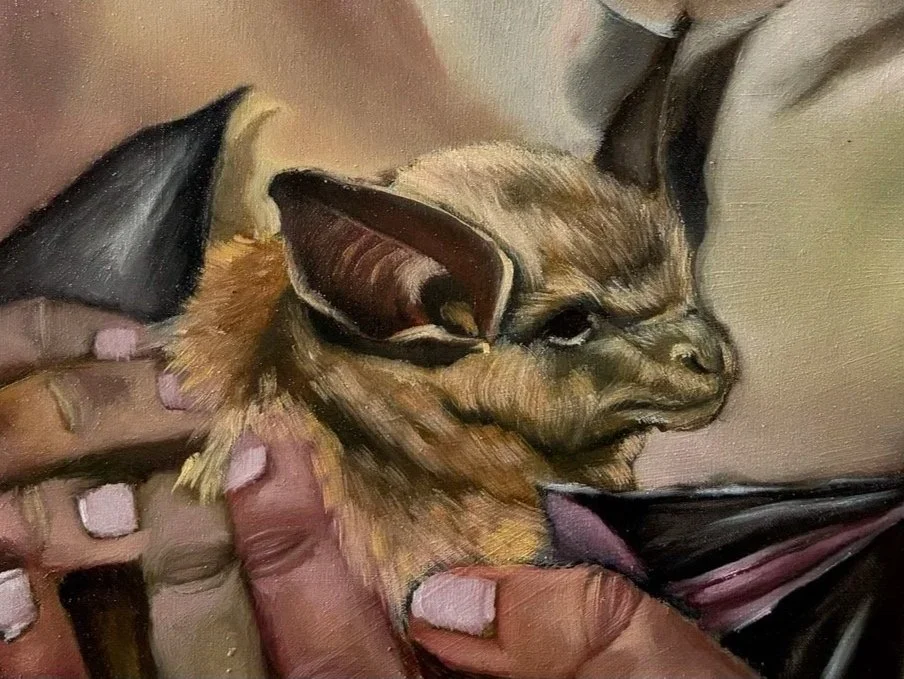
detail look at Petite Batterie
The image is strangely tender, yet deeply unsettling. Bats are delicate creatures, and too much human contact can be fatal. The gesture becomes both loving and dangerous at the same time. Within that contradiction, Simpson finds herself repeatedly returning to the same thought.
"What if I put my nightmares and dreams on a canvas, so they can communicate on the same pedestal?"
Perhaps that is the question that runs through all of her paintings. Not one that asks us to solve an image but one that invites us to remain inside it just a little longer.
From Arthoods
When we first encountered Estelle Simpson's paintings, we were drawn to their atmosphere. After this conversation, we realised it was not simply the imagery that stayed with us. It was the way she invited us to look more closely.
As we returned to her paintings, we found ourselves noticing details we had previously overlooked. A bar of soap quietly becoming a cat. Pins piercing soft surfaces. Candle wax slipping onto skin. These paintings had not changed.
We had.
Perhaps this is what makes Estelle's practice so compelling. It does not ask us to find certainty. Instead, it rewards patience, curiosity, and careful looking. The longer we spend with her work, the more it quietly unfolds.
Long after closing her sketchbook, one image remained with us. A simple pin cushion. Soft. Familiar. Quietly pierced. It became a reminder that even the most ordinary objects can carry extraordinary emotional weight. If only we learn to look.